Bright Minds.
New for 2026: The 3-day summer Lab Bench Workshop — July 14–16 · Boise · 8 spots
Fall 2026 Cohort · 8 Saturdays · Treasure Valley

A pre-health lab cohort, taught by the person who runs the labs your kid will hit in college.

Eight Saturday mornings. Real dissection, real microscopy, real lab notebooks. Capped at eight students, 7th–12th grade. Led by Leslie Nichols — Boise State's Anatomy & Physiology Laboratory Coordinator, Idaho-certified, and a veteran public-school middle- and high-school biology teacher.

No payment required to reserve. We'll confirm details by email before any commitment.

Gloved teen hands working on a teaching-grade preserved fetal pig specimen on a black dissection tray, with an open mammalian-anatomy reference book beside.
Real specimens. Real benches.
When
8 Saturdays, Sep–Nov 2026
9 AM–noon · Sep 12 → Nov 14

Skips fall break & Halloween.

Where
Boise, ID
Treasure Valley · ample parking

Exact venue in confirmation email.

Who
8 students max
7th–12th grade

Sibling discount available.

Tuition
$695 / cohort
All specimens & materials included

Need-based scholarships — ask.

Hands writing in a lab notebook beside a microscope and an open anatomy reference book.
Meet your instructor

Leslie Nichols — a credentialed lab specialist who loves teaching this age.

  • · BSU A&P Laboratory Coordinator (27+ labs, 1,000+ students per term)
  • · BSU A&P lecture & lab instructor
  • · Public-school middle & high school biology teacher (Idaho-certified)
  • · 22-year homeschool co-op leader
More about Leslie →

Fall cohort isn’t the only way to work with Leslie. See all 3 packages →

The offer

An 8-Saturday Life Sciences Intensive

A comparative-anatomy spine. A pre-health-grade capstone. Small enough that every student does every lab.

8
Saturday mornings

~3 hours each, 9 AM–noon. One semester, beginning to end. Skip-friendly with structured make-ups.

8
Students max

7th–12th grade. Every student handles every specimen. No "watch from the back of the room."

1
Real lab notebook

Each student finishes with a working pre-health lab notebook and a letter of completion from their instructor.

What this is: a small, mastery-based lab-bench cohort taught by a credentialed Idaho science teacher. We move on when students can do the work, not when the calendar says so — and the deeper goal is to teach students how to reason through the scientific method on their own. Reference curriculum (OpenStax, Khan Academy) is commodity and free; the instructor, the bench, and the habits of mind are what this cohort is built around.

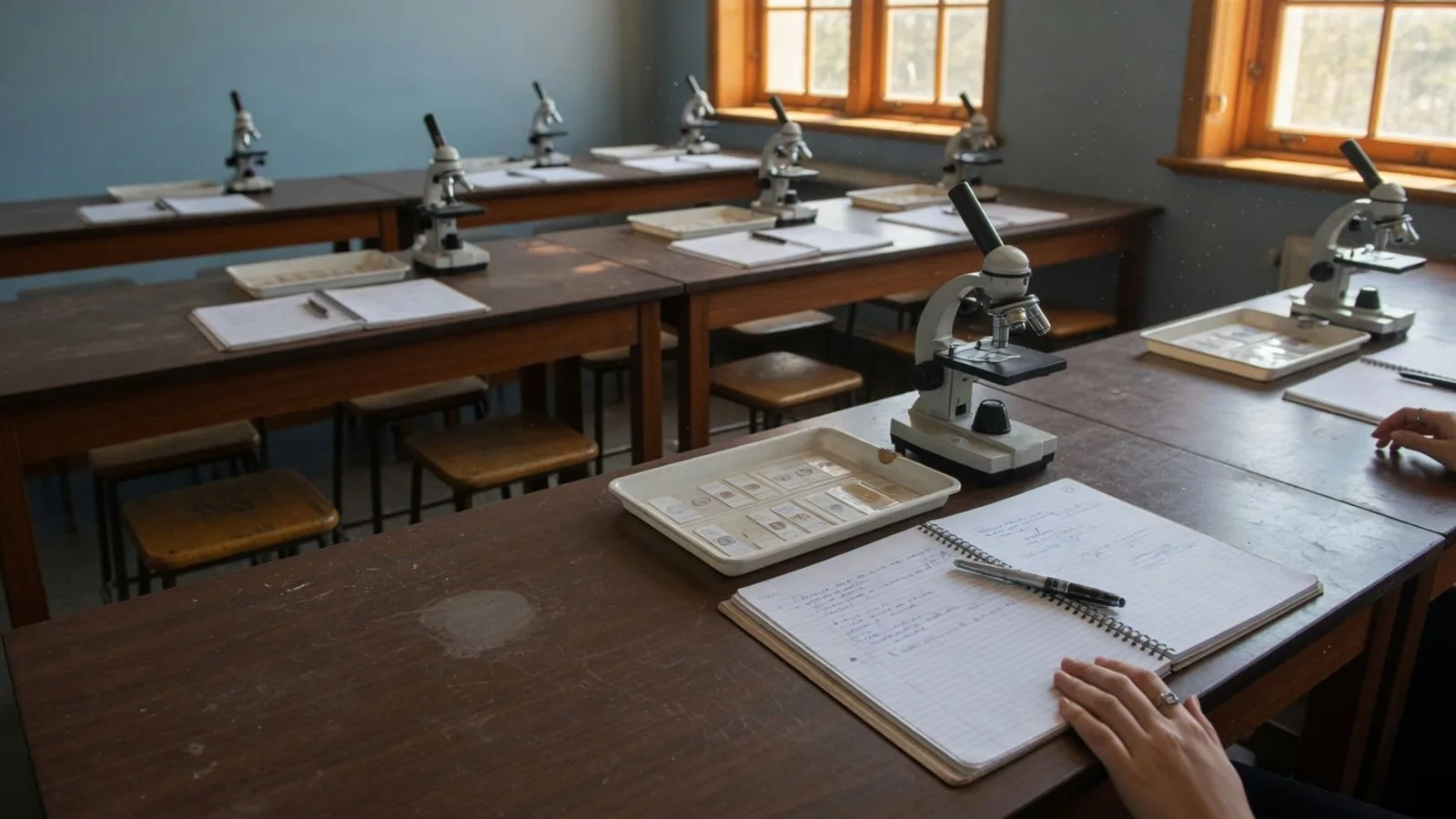
A high-school science lab at 9 AM: paired wooden benches with compound microscopes, slide trays, and open lab notebooks.
What students actually do

Real labs, not lab simulations.

Across 8 Saturdays, students work through a comparative-anatomy spine that mirrors a college-freshman pre-health track — just calibrated for high-school maturity and attention.

Specimens, microscopes, and models stay on the bench. Lab notebooks travel home each week. The capstone is a real piece of work the student can show on a transcript or an application.

  • Microscopy fundamentals — cells, tissues, what to actually look for.
  • Tissue identification — the four big classes, with real slides.
  • Comparative dissection (invertebrate) — the warmup specimen.
  • Comparative dissection (vertebrate) — the comparison.
  • Anatomy & physiology blocks — bones, muscles, organs, with real models.
  • Capstone project — student-driven; final week is presentation + portfolio review.
Inside the lab

Real benches. Real specimens. Real lab notebooks.

Empty lab classroom at 9 AM: paired microscopes, slide trays, and open lab notebooks await students.
Saturday morning · 9 AM — benches set, slides ready
Hands adjusting the focus on a compound microscope above a hand-drawn cell sketch in a lab notebook.
Microscopy · week 1 — cells & tissues
A wooden slide tray of 12 hand-labeled prepared microscope slides with stainless forceps beside it.
Tissue ID · week 2 — the four big classes
Gloved hands working on a preserved fetal pig specimen on a dissection tray with a mammalian-anatomy book open beside.
Dissection · week 4 — comparative anatomy
A small vertebrate teaching skeleton on a black velvet pad with a wooden probe pointing at a vertebra.
Skeletal anatomy · week 5 — bones & joints
A lab notebook open to a two-page spread: handwritten observations on the left, careful labeled anatomy drawing on the right.
Lab notebook · weekly — pre-health record-keeping
A folded tri-fold display board on a workbench with hand-drawn diagrams and a printed certificate of completion beside it.
Capstone · week 8 — portfolio + presentation
An articulated teaching skeleton in a brown fedora and paisley necktie leaning against a chalkboard with a labeled spine sketch.
Lab regulars · Mr. Bones, anatomy & physiology
An articulated teaching skeleton in a fedora and paisley necktie seated at a wooden bench, peering through a compound microscope with an open lab notebook beside.
Lab regulars

Meet Mr. Bones.

Bright Minds’ unofficial mascot — fedora, paisley necktie, and a strong opinion about every joint in the human body. He’s on the bench for the Fall 2026 cohort, ready to point at things on cue.

Articulated. Slightly battered. Excellent at posing for photos.

New for 2026 · Summer workshop

Try it before you commit — The Lab Bench Workshop, July 14–16.

Three July mornings. Real microscopy and dissection. $245 — with $100 credit toward Fall cohort.

See workshop →

Eight seats. One cohort.

Reserve your student's seat for Fall 2026. Reservation is non-binding — we'll send schedule and tuition details before any commitment.

Reserve a spot →

Questions? Read the FAQ or see the pathway.