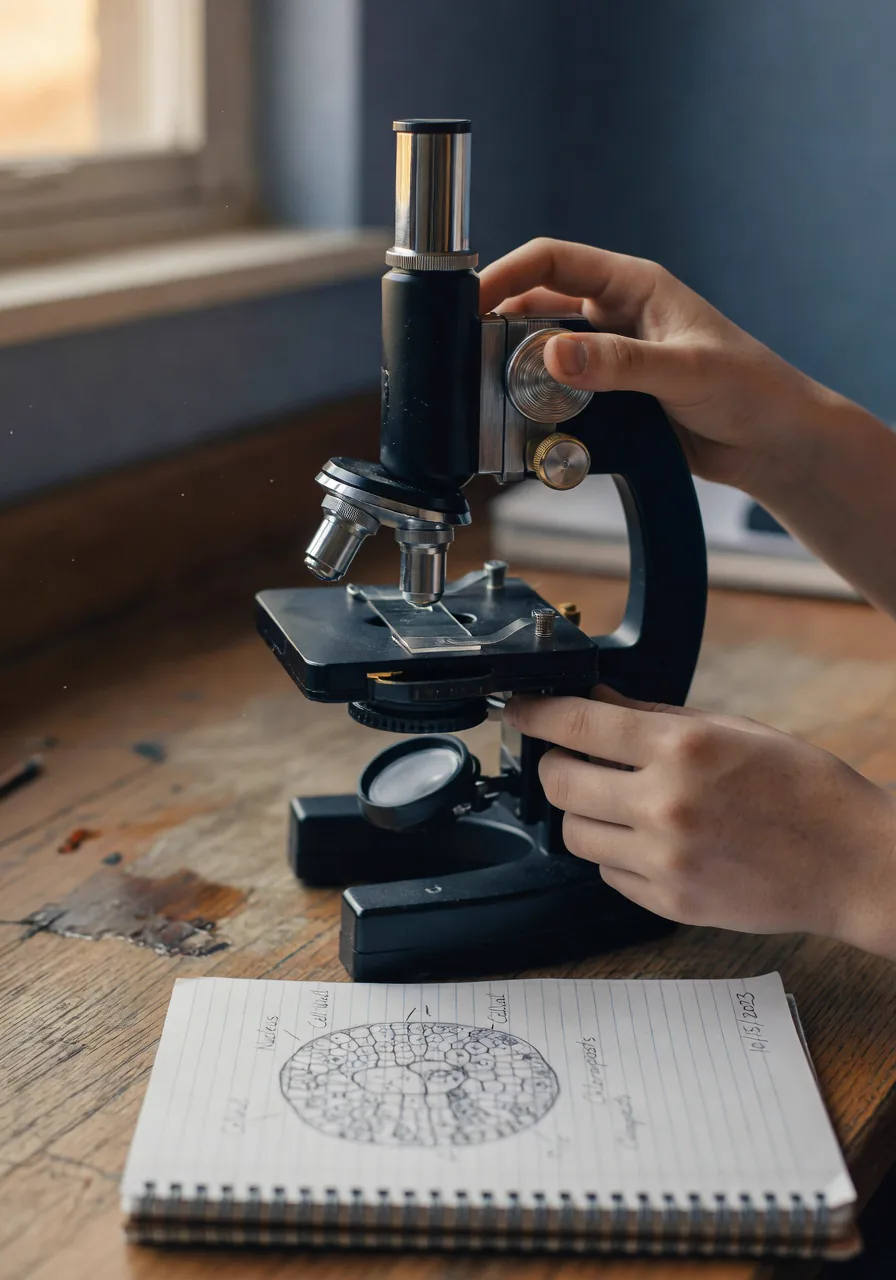
Why hands-on lab science matters more, not less, in the video-learning era.
K–12 and college science classes are shifting toward videos, simulations, and virtual labs. Students show up to college, medical school, and nursing programs with degrees on paper and very little bench under their hands. What the research says about that gap and why we built our Saturday cohort the way we did.
During my years teaching at BSU, every fall brought a fresh class of nursing, pre-med, kinesiology, and biology students into the Anatomy & Physiology lab. They had passed high-school biology. Many had taken AP Biology. Some had an associate’s degree in hand. And every year, more arrived without having used a real microscope, held a scalpel, or written a structured observation in a bound notebook. The first time they stood in front of a tray of preserved tissue, they looked at me the way you’d look at a snake.
That’s not a complaint about the students. They’re bright, well-prepared on paper, and working hard. It’s a comment on what “science class” has quietly become in a lot of K–12 schools and even some lower-division college courses: a video, a quiz, a simulation, and a worksheet. The bench has been removed.
“A degree on paper, and very little bench under their hands.”
Why this happened
The shift toward video-and-simulation science instruction was already underway before 2020 through flipped classrooms, online dual-credit courses, and virtual dissection apps, and the pandemic pushed many schools further in that direction, at least for a time. For a school administrator, video lessons are easier to schedule, easier to staff, easier to assess, and usually cheaper than a real wet lab. Virtual dissection software is a sound route for a student who opts out of dissection, but in too many classrooms it has become the default rather than the alternative.
Even at the college level, some courses have moved toward “screencast plus quiz” delivery for foundational concepts, with lab time shortened or replaced with a virtual lab. By the time a student reaches a clinical rotation or a research lab, the gap between what their transcript says they know and what their hands can actually do can be large.
What the research actually says
The case for active, hands-on science instruction isn’t a feeling. It’s one of the better-documented findings in education research. A few signposts:
- Active learning is significantly more effective than passive lectures. A landmark 2014 meta-analysis published in the Proceedings of the National Academy of Sciences pooled 225 studies of undergraduate STEM courses. On average, exam and concept-inventory performance was 0.47 standard deviations higher with active learning (about half a letter grade, by the authors’ estimate), and students in traditional lecture courses were about 1.5 times as likely to fail: average failure rates of 33.8% under lecturing against 21.8% under active learning.1 The authors wrote that the results “raise questions about the continued use of traditional lecturing as a control in research studies.” Active learning covers more than lab work — discussion, problem-solving, and retrieval count too — so these numbers support learning by doing, not any one format.
- Labs can teach reasoning, not just content. In a 2015 PNAS study, Holmes, Wieman, and Bonn taught introductory physics lab students to compare their measurements with each other and with models, and to decide what to change next, with the guidance gradually withdrawn. Those students kept reasoning that way on their own; students in the standard labs mostly did not.2 The lesson isn’t “labs good, video bad.” It’s “the labs that work are the ones where students have to think.”
- Science scores have fallen since 2019. On the 2024 National Assessment of Educational Progress, eighth graders’ average science score was 4 points lower than in 2019.3 Pandemic disruption is a likely part of the story, but the assessment cannot separate the effect of virtual instruction from everything else that changed, or say which skills suffered most.
- Health-professions educators have raised related concerns. In one large medical center’s assessments of more than 5,000 newly hired nurses, fewer than one in four met its clinical-judgment expectations.4 That was one hospital system, before the pandemic, and the report does not identify a cause. It is a reason to assess practical skills directly, not proof of what produced the gap.
You can watch a thousand hours of video on how to use a microscope and still not be able to find a cell on a slide on the first try. The skill lives in your hands and your eyes, not in your head.
What hands-on lab work actually teaches
When parents ask me what the difference is between watching a great dissection video and standing at a bench with a real specimen, I usually list four things. None of them is “the content.” The content you can mostly get from a book.
1. Procedural fluency
Holding instruments correctly, focusing a microscope without crashing the objective, transferring a slide without contaminating it, making a cut at the right depth. These are motor skills, and the brain learns them the same way it learns to ride a bike: by doing, badly, and then better. No video shortcuts that loop.
2. Structured observation
Looking at a tissue and writing down what is actually there, not what the textbook said would be there, requires attention. Ask the student to identify the visible features, label the observation, and separate it from their interpretation. A picture or video can help with preparation, but the student's record should describe the specimen being examined.
3. Reasoning under uncertainty
A real specimen is messy. Slides have artifacts. Equipment fails. Reagents go bad. The student has to ask: is this an interesting result, or did I make a mistake? Learning to answer that question and design a check is part of scientific reasoning. Written problems can rehearse those decisions; practical work gives students actual measurements and equipment to examine.
4. The habit of teaching yourself
Maybe the most important one, and the hardest to test. A student who has worked through enough labs eventually realizes that a textbook, a paper, or even a specimen they’ve never seen before is approachable: they have a method for breaking it down. That habit, the willingness to look at the thing instead of waiting for someone to explain it, is what college, medical school, and the working world actually need from their graduates. It’s also what video-only instruction gives a student little chance to build.
A small-group teaching example
An eight-student, eight-session laboratory course is one example of how this approach could be organized. It is not a current class announcement. The purpose is to give students supervised practical work and feedback that complements their other science study.
Every Saturday, every student handles every specimen. Every student keeps a dated, structured lab notebook to a pre-health rubric. Every student has to explain their work, in plain English, to a peer at the bench, because if you can’t teach it, you don’t actually understand it. And every student finishes with a capstone presentation: here is what I observed, here is what I think it means, and here is what I’d do differently next time.
The notebook and practical assessments would record what students observed, explained, and demonstrated. A record of completed work is useful, but it is not proof that a student can handle every unfamiliar laboratory task.
The goal is clear: students should practice the skills the course claims to teach, and the instructor should have evidence of what they can do.
Sources & further reading
- Freeman, S., Eddy, S. L., McDonough, M., et al. (2014). “Active learning increases student performance in science, engineering, and mathematics.” Proceedings of the National Academy of Sciences, 111(23), 8410–8415. doi:10.1073/pnas.1319030111. Meta-analysis of 225 studies: average failure rates were 33.8% under traditional lecturing vs. 21.8% under active learning (about 55% higher under lecturing), and exam and concept-inventory performance improved by 0.47 standard deviations with active learning.
- Holmes, N. G., Wieman, C. E., & Bonn, D. A. (2015). “Teaching critical thinking.” Proceedings of the National Academy of Sciences, 112(36), 11199–11204. doi:10.1073/pnas.1505329112. Lab students explicitly trained to compare data sets and revise their reasoning kept that skill a year later; standard cookbook-lab students did not.
- National Center for Education Statistics, “The Nation’s Report Card: Science” (2024 results, grade 8). The average score was 4 points lower than in 2019. The assessment reports the change; it does not identify its causes.
- Kavanagh, J. M., & Szweda, C. (2017). “A Crisis in Competency: The Strategic and Ethical Imperative to Assessing New Graduate Nurses’ Clinical Reasoning.” Nursing Education Perspectives, 38(2), 57–62. Post-hire, pre-start assessments at one large Midwestern medical center; not a nationally representative sample.
- Further reading: President’s Council of Advisors on Science and Technology (2012), “Engage to Excel: Producing One Million Additional College Graduates with Degrees in Science, Technology, Engineering, and Mathematics.” The federal report that put the STEM-attrition figures, along with the recommendation to replace introductory lectures with active, lab-based instruction, on the national agenda.
A note on this essay: claims about active learning, lab-based critical thinking, and STEM attrition reflect well-documented findings in education research; the primary sources are linked above. Observations about how science classes have changed come from the author’s teaching experience and are not measured trends.