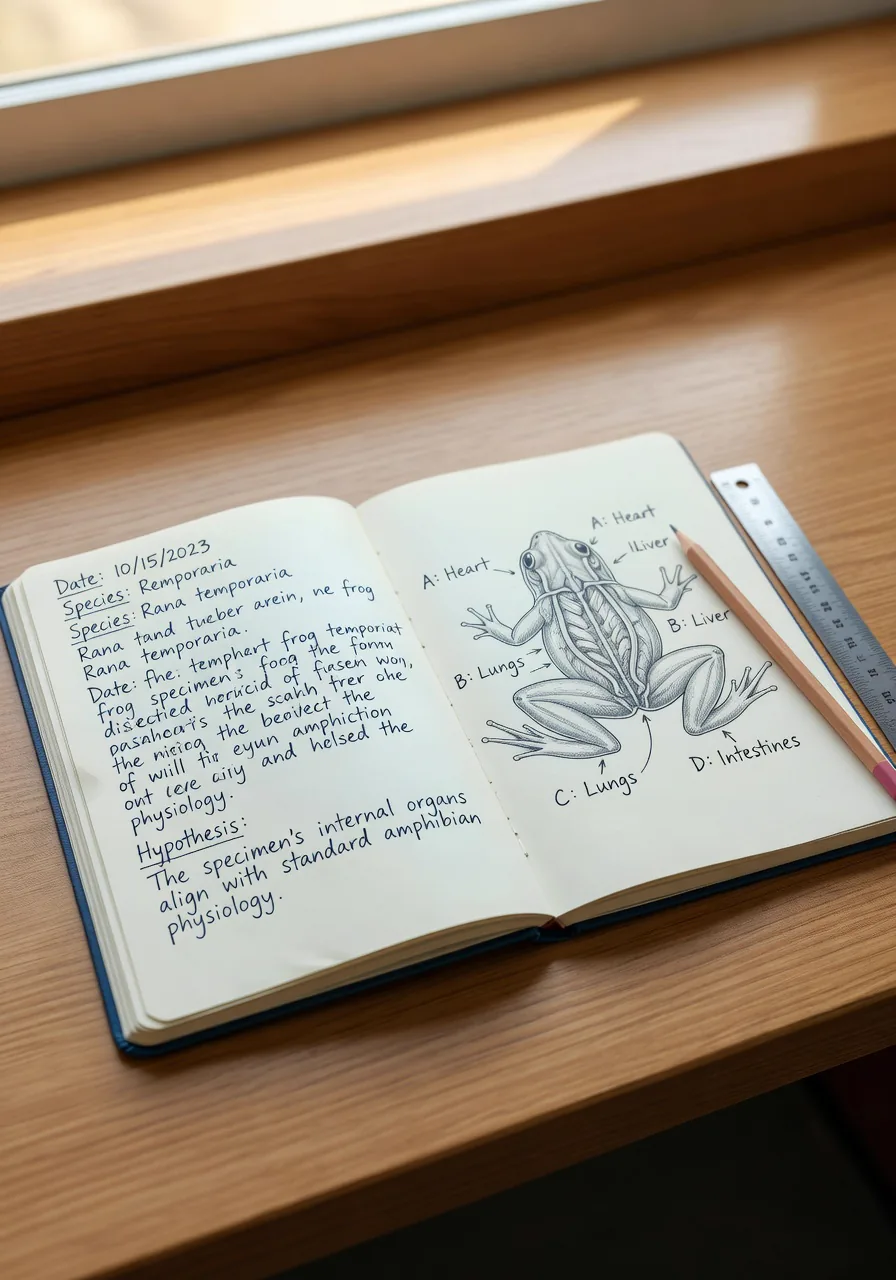
Why a real lab notebook beats a Google Doc.
A notebook should record observations as they happen and preserve corrections. I use bound books to teach those habits. The same responsibilities apply when a student uses a digital record.
Why use a bound notebook when typing may be faster? The purpose is not to make work slow. It is to keep observations, drawings, and corrections together in a record that can be checked later.
A composition book is a practical starting point. Students can see the sequence of entries and preserve earlier observations without learning a separate piece of software.
A reliable notebook records what happened, including corrections.
What a real notebook actually is
In a working research lab, a notebook isn’t a study tool. It’s a primary record. It’s the document a regulator, a co-author, or a future graduate student opens to find out what actually happened on the bench. Research settings have their own record-keeping requirements. In a classroom paper notebook, dated entries and legible corrections teach students to preserve what they observed.1
Those rules sound fussy until you ask why they exist. They exist because a notebook should let someone trace what was observed, when it was recorded, and how an entry was corrected. It preserves the measurements and uncertainty, not only the final explanation.
Choosing and maintaining a record
Digital records can preserve revisions, drawings, and backups. A bound notebook makes some of those habits visible without additional software. Either format needs deliberate record-keeping:
- Preserve the sequence. Date observations and corrections. In a digital record, keep the revision history accessible. In a paper record, leave the original entry legible beside the correction.
- Keep the original observations. A corrected measurement should not silently replace the first reading. Record the change and why it was needed.
- Make time to observe. A drawing should describe the specimen in view. Whether made on paper or with an appropriate digital tool, it needs accurate labels and a connection to the recorded observations.
Drawing as a way of seeing
A useful way to review progress is to compare two drawings of similar material. Are the labels more accurate? Has the student noticed features they missed before? Can they explain a correction? These questions make the purpose of the drawing clear.
This is an observation lesson, not an art competition. Students move between the eyepiece and the page, asking is that what I saw? and checking the drawing against the specimen. Naturalists from Darwin to E. O. Wilson kept this habit for a reason. It’s the oldest tool in the kit.
You can take a thousand photos of a leaf and never look at it. You can’t draw it without looking.
The artifact that goes home
By week eight, every Bright Minds student walks out with a bound book containing roughly fifty pages of dated, structured, pre-health-style entries: protocol, observations, drawings, sources of error, and a short discussion. Mistakes left in. Re-thoughts initialled. The kind of book a college admissions reader, a research mentor, or a nursing program interviewer can open.
That artifact does two things at once. It’s a portfolio piece suitable for an academic record, providing a concrete answer to the question “what have you actually done?” And it’s a mirror. The student can flip back to week one and see the difference between how they observed a tissue then and how they observe one now. Almost nobody finishes the cohort without that page being a small, private win.
Why we don’t budge on this
I prefer bound notebooks for this teaching because they make the sequence of work easy to review. Write what you observed, preserve corrections, label drawings, and date each entry. Those are the habits the instructor should teach and check.
The habits matter more than the medium. When an accommodation or course requirement calls for a digital record, agree how it will preserve observations, corrections, drawings, and dates. Paper alone does not guarantee a reliable record.
Choose a practical format, then teach students to use it carefully.
Sources & further reading
- The standards for a legally and scientifically defensible laboratory notebook (bound, dated, in ink, with single-line corrections that preserve the original entry and signed, dated changes) are codified in U.S. FDA Good Laboratory Practice regulation 21 CFR Part 58. See in particular § 58.130(e): “All data … shall be recorded directly, promptly, and legibly in ink. All data entries shall be dated on the date of entry and signed or initialed by the person entering the data. Any change in entries shall be made so as not to obscure the original entry, shall indicate the reason for such change, and shall be dated and signed.” The canonical short reference for students is Howard M. Kanare, Writing the Laboratory Notebook (American Chemical Society, 1985).
- On drawing as scientific observation: see Charles Darwin’s Beagle field notebooks for the long tradition of illustrated naturalist journals; and Edward Tufte’s books (The Visual Display of Quantitative Information, Envisioning Information) on why drawing forces decisions about what is and isn’t actually there.
Posted Apr 30, 2026.