Teaching examples, not student testimonials. The sample week, model notebook, and demonstration prompts illustrate the intended learning process; they do not report an enrolled student's results. Current program status and next steps.
Look inside the Biology pack.
No sign-up, no email required. Here is a sample week, a real rubric, a model lab-notebook entry, and a sample demonstration. These are the materials themselves, not a brochure. Every sample links to the full artifact it’s drawn from.
One week, two days at the bench.
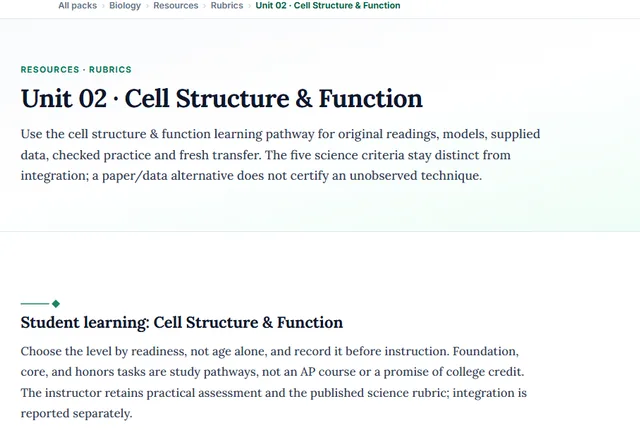
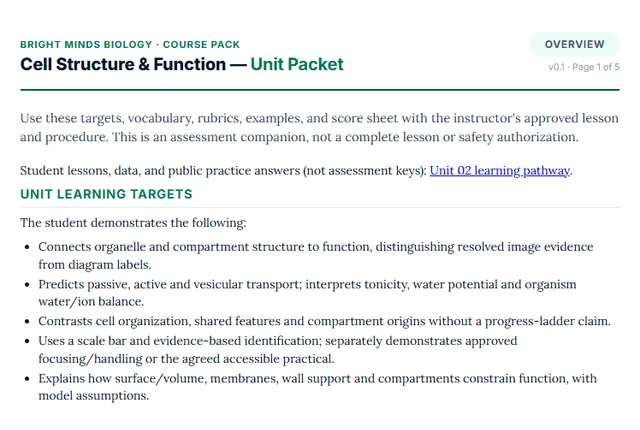
The course meets two days a week for about two hours a day, across roughly 32 weeks. Here is week one of Unit 2 — Cell Structure & Function: the student meets the microscope and the cell for real before a single term is memorized.
- Cell structures & their functions
- Magnification vs. resolution
- Reading: OpenStax cell section
- Wet-mount preparation
- Focus & light technique
- Sketch with scale & labels
How “mastered” is actually judged.
Every skill is scored at one of three levels against a published standard, without points or grading on a curve. Here is one criterion from the microscopy identification rubric, shown exactly the way a parent or guide reads it:
| Level | What it looks like — “Identify structures on a prepared slide” |
|---|---|
| Developing | Cannot yet locate or name the required structures on the actual slide, or names them from memory of a textbook image rather than the field in view. |
| Proficient | Finds and names most required structures, but misses some, needs prompting, or can’t hold the identification under a follow-up question. |
| Mastery | Locates and correctly names every required structure on the real specimen, unaided, and holds up when asked “how do you know?” |
The artifact a student builds, keeps, and defends.
The lab notebook is the primary record of a student's work, written in pen at the bench and explained aloud. Here is one model Experiment Day, showing how each section is recorded. Notice the crossed-out timing slip and the honest sources of error.
| Solution | Start (g) | Final (g) | Δ (g) |
|---|---|---|---|
| 0% (distilled) | 4.02 | 4.34 | +0.32 |
| 5% salt | 4.05 | 3.86 | −0.19 |
| 10% salt | 3.98 | 3.40 | −0.58 |
- Dating & numbering
- Pre-lab sections
- In-the-moment notes
- Observation vs. interpretation
- Sketch conventions
- Single-line error correction
- Session summaries
The moment that can’t be faked.
Three times a year, a student performs and defends a demonstration, standing with their own work and reasoning aloud while an adult asks unscripted follow-ups. It’s how the course certifies real understanding, and it’s why AI can’t do the work for them.
“This is the diaphragm — a sheet of muscle separating the chest from the abdomen. I can see the lungs on the chest side and the liver on the abdominal side.”
A passing answer from the fetal-pig dissection defense — reasoning from the actual specimen, not a memorized phrase.
The whole pack, ready for a binder.
Everything here is available to read online. Every rubric, checklist, and guide also has a print-ready packet version, formatted 8.5×11 for a clipboard or a three-ring binder. You assemble the student’s binder from the pack itself; there’s nothing else to buy to hold it in your hands. We’ve put them all in binder order on one page: Assemble the Biology binder →
Seen enough to start?
The whole Biology pack is open to read and print. Open it and begin, or ask us a question first. A real person answers.